

What Is Heat Tint in Welding? Acceptance Criteria and Prevention Methods
- Blog
- What Is Heat Tint in Welding? Acceptance Criteria and Prevention Methods
What Is Heat Tint in Welding? Acceptance Criteria and Prevention Methods
Table of Contents
- How Does Heat Tint Form?
- Why is Heat Tint Important?
- How Are Acceptance Criteria Determined?
- How is Internal Gas Shielding (Purging) Performed?
- The Effect of Orbital Welding on Discoloration
- What to Do When Discoloration Occurs?
- Test Welds and Quality Assurance
- Field Measures to Reduce Discoloration
- Frequently Asked Questions
- Conclusion
After welding stainless steel pipes, colors ranging from pale straw yellow to blue, or even dark gray, may be observed around the weld seam. This color change is called heat tint. Although it may appear to be an aesthetic flaw from the outside, it is directly linked to corrosion resistance in hygienic piping systems. In this article, we discuss how heat tint forms, why it matters, and how it can be kept under control.
How Does Heat Tint Form?
During welding, the metal reaches extremely high temperatures. If oxygen is present in the environment at this temperature, a thin oxide layer forms on the surface. As the thickness of this layer increases, it reflects light differently, giving rise to visible colors. Light straw color indicates a very thin oxide layer, while blue and darker tones signify a thicker layer.
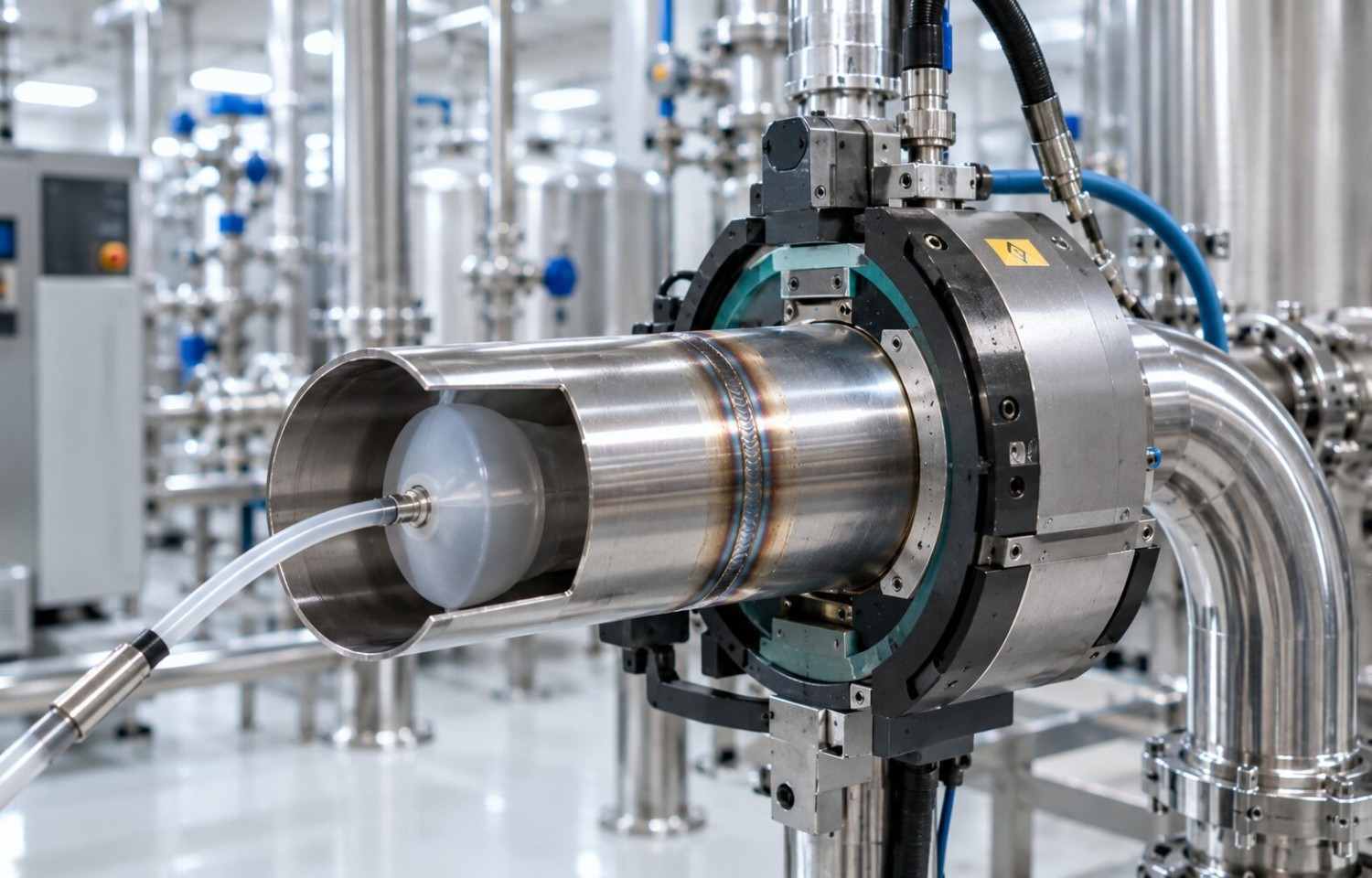
In pipe welding, this condition can occur on both the outer and inner surfaces. While the outer surface is protected by the shielding gas coming from the welding torch, protecting the inner surface requires introducing gas inside the pipe separately. This process is known as internal gas shielding or purging.
Why is Heat Tint Important?
The corrosion resistance of stainless steel stems from the chromium-rich passive layer that forms naturally on its surface. The oxide layer formed during welding disrupts this balance. In the region immediately beneath the oxide layer, chromium content can be depleted. This makes that area more susceptible to corrosion, particularly pitting corrosion and rouging formation.
Furthermore, a thick and irregular oxide layer reduces surface smoothness, which is undesirable for cleanability in hygienic piping applications.
How Are Acceptance Criteria Determined?
In hygienic piping, heat tint is typically evaluated using color reference charts. On these charts, color shades corresponding to increasing oxide levels are numbered. Project specifications state the allowable level of discoloration on internal surfaces. In pharmaceutical and biotechnology projects, criteria from ASME BPE are frequently referenced; only very light shades are permitted on product-contact surfaces.
It is crucial that the acceptance criteria are understood uniformly by the welding crew, quality control personnel, and the client prior to installation. When evaluation is conducted using borescope images, it should be remembered that lighting conditions and camera settings can affect color perception.
How is Internal Gas Shielding (Purging) Performed?
The primary way to prevent internal surface discoloration is to displace oxygen inside the pipe during welding. For this purpose, an inert gas such as argon is introduced into the pipe, and air is allowed to be fully purged. Key points to consider for effective internal gas shielding include:
- Restricting the purged area using plugs or bladders to minimize volume
- Flowing gas for a sufficient duration prior to welding to displace oxygen
- Monitoring the remaining oxygen level using an oxygen analyzer
- Maintaining gas flow during welding and until the weld cools down
- Ensuring there are no leaks in the gas hose and connections
The Effect of Orbital Welding on Discoloration
Automatic orbital TIG welding ensures controlled and repeatable heat input. The more balanced the heat input, the more predictable the discoloration. Because the weld zone is enclosed within a chamber surrounded by shielding gas in orbital welding heads, the outer surface is also better protected. For this reason, orbital welding has become the standard method in hygienic projects targeting minimal heat tint.
What to Do When Discoloration Occurs?
When discoloration exceeding acceptance criteria is identified, there are two approaches. The first is to cut out and re-weld the joint; this is preferred especially when heavy discoloration occurs on internal surfaces where physical access is impossible. The second is removing acceptable levels of discoloration through chemical treatments. Passivation applied to the entire line after installation helps clean light oxide layers and supports the reformation of the passive layer. However, passivation should not be viewed as a remedy for severe discoloration resulting from inadequate internal gas shielding.
Test Welds and Quality Assurance
Test welds performed prior to starting assembly and at the beginning of each shift are the most practical way to verify that internal gas shielding and welding parameters are functioning correctly. The test weld is sectioned to inspect its internal surface, and the result is documented. Performing a new test weld is also recommended following gas cylinder replacement, hose changes, or adjustments to welding machine settings. This simple practice prevents an undetected field issue from spreading across dozens of welds.
Field Measures to Reduce Discoloration
Weld quality is not only about equipment and gas. Clean, grease-free pipe ends, burr-free cutting, proper end alignment, and protecting the weld zone from external factors like draft directly influence discoloration. Pipe ends contaminated by or in contact with carbon steel tools cause both discoloration during welding and initiation points for future corrosion. Therefore, using a dedicated tool set and maintaining a clean workspace are fundamental rules in stainless steel installation.
Frequently Asked Questions
Is discoloration on the outer surface also an issue?
Because the outer surface does not come into contact with the product, acceptance criteria are generally more flexible. However, cleaning the outer surface may also be requested in corrosive environments or where aesthetic expectations are high.
Can a measuring instrument be used instead of a color chart?
Color evaluation in practice is largely performed visually. Laboratory methods for analyzing oxide layers may be used in certain projects, but color reference charts and documented imagery remain the most common methods in the field.
Can gases other than argon be used?
Argon is the most common gas used for internal shielding. Different gas mixtures may be used in specific applications; however, the selected gas must be defined in the welding procedure and match the gas used during qualification testing.
Heat tint is a quality indicator in stainless steel welding that should not be overlooked. With proper internal gas shielding, controlled heat input, clean working conditions, and pre-defined acceptance criteria, discoloration can be maintained within allowable limits. Contact us to learn more about our installation services and welding quality methodology.