

What Is the Pressure Equipment Directive (PED)? Its Impact on Tank and Piping Projects
- Blog
- What Is the Pressure Equipment Directive (PED)? Its Impact on Tank and Piping Projects
What Is the Pressure Equipment Directive (PED)? Its Impact on Tank and Piping Projects
Table of Contents
- What is PED?
- Which Equipment Does it Cover?
- How is the Category Determined?
- Sound Engineering Practice (SEP)
- Conformity Assessment and Notified Bodies
- Impact on Vessel and Piping Projects
- Balancing PED with Hygienic Design Requirements
- Technical Documentation and Files
- Periodic Inspections During Operation
- Common Pitfalls
- Frequently Asked Questions
- Conclusion
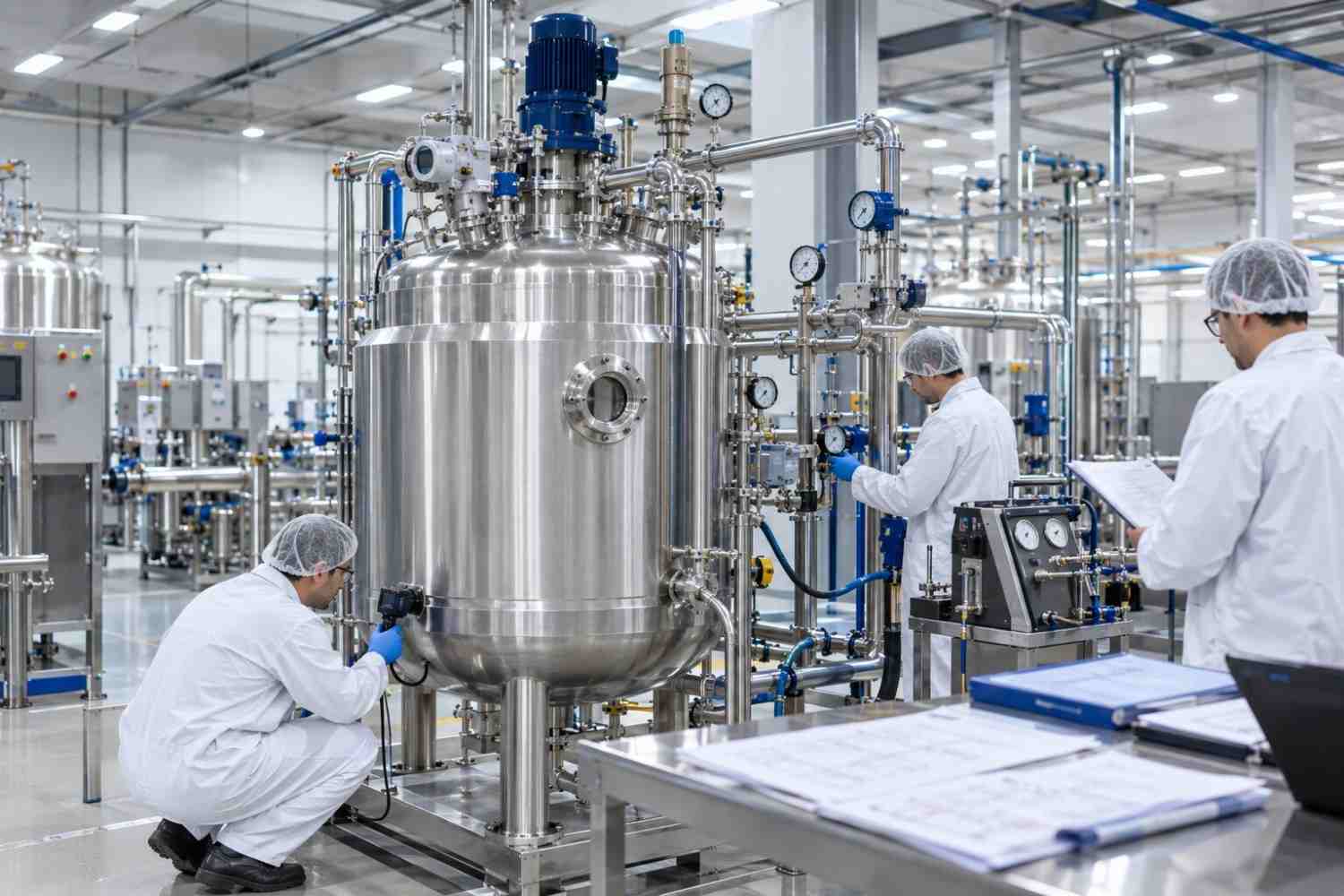
A significant portion of process vessels, heat exchangers, filter housings, and piping systems operate under pressure. The failure of pressurized equipment presents serious risks to personnel safety, the environment, and operational continuity. Consequently, the design, manufacturing, and conformity assessment of pressure equipment in the European Union and internationally are governed by strict regulatory frameworks. The foundation of these requirements is the Pressure Equipment Directive, universally known as PED. In this article, we outline what the PED entails and how it influences vessel fabrication and piping engineering projects.
What is PED?
PED refers to European Union Directive 2014/68/EU on Pressure Equipment. It establishes the essential safety requirements (ESRs) and conformity assessment procedures for the placing on the market of pressure equipment and assemblies with a maximum allowable pressure (PS) greater than 0.5 bar.
The directive aims to guarantee the safe design and fabrication of pressure equipment while harmonizing standards to ensure free movement of compliant products within the global marketplace.
Which Equipment Does it Cover?
The directive applies broadly to the following pressure equipment categories:
- Pressure Vessels: Storage tanks, reactors, jacketed vessels, filter housings, and process receiver units.
- Piping Systems: Pipelines and piping components intended for transporting process fluids under pressure.
- Safety Accessories: Direct pressure relief devices, rupture discs, and safety interlock systems.
- Pressure Accessories: Valves, pressure regulators, strainers, and inline pressure-bearing components.
- Assemblies: Integrated systems composed of multiple pieces of pressure equipment assembled to form an operational unit.
Certain equipment types governed by specialized alternative directives (such as transportable pressure equipment) are excluded from the scope. Equipment boundaries must be evaluated thoroughly at the initial engineering phase.
How is the Category Determined?
Equipment within the scope of the PED is classified into risk categories ranging from Category I to Category IV. The hazard category depends on several key parameters:
- Equipment classification type: vessel, piping, or accessory
- Physical state of the fluid: gas, vapor, or liquid
- Fluid classification group: Group 1 (dangerous/hazardous) vs. Group 2 (all other fluids)
- Maximum allowable pressure (PS)
- Internal volume (V) for vessels, or nominal size (DN) for piping systems
These values are plotted on statutory directive charts to identify the governing risk category. Higher categories impose more rigorous conformity assessment procedures and require direct oversight from a accredited Notified Body.
Sound Engineering Practice (SEP)
Equipment operating below the lower thresholds of Category I falls under Sound Engineering Practice (SEP). SEP equipment must be designed and manufactured in accordance with established engineering principles to ensure safe usage. While SEP equipment does not bear the CE mark, it must be accompanied by adequate instructions for use and full material traceability.
Conformity Assessment and Notified Bodies
Depending on the designated risk category, the PED defines various conformity assessment modules. While lower-risk categories permit manufacturer self-declaration via internal production controls, higher-risk categories require Notified Body involvement for design appraisals, manufacturing inspections, welding audits, and final proof testing. Once compliance is verified, the equipment is issued a CE Declaration of Conformity and stamped with the CE mark.
Impact on Vessel and Piping Projects
Adhering to PED standards impacts every project phase, from conceptual design to site handover. Key milestones include performing validated mechanical strength calculations, sourcing certified and traceable materials, qualifying welding procedures (WPS/PQR) and welders (WPQ), carrying out non-destructive examination (NDE), and executing hydrostatic pressure testing. All records are compiled into the official technical file. We incorporate these regulatory milestones into our vessel fabrication and filter housing manufacturing workflows from project kick-off.
Balancing PED with Hygienic Design Requirements
Pressurized equipment installed in pharmaceutical, food, and biotechnology facilities must simultaneously fulfill mechanical pressure safety and sanitary design standards. For example, a jacketed processing vessel requires robust wall thickness calculations to satisfy the PED while demanding crevice-free, high-grade polished surface finishes internally. Because heavy wall thicknesses or structural reinforcement can complicate sanitary weld geometry and surface treatment, mechanical and hygienic engineering must be executed concurrently by an integrated design team.
Technical Documentation and Files
The technical file for PED-compliant equipment comprises structural calculations, manufacturing drawings, material test report (MTR) certificates, welding qualifications, NDE/pressure test reports, risk assessments, operating manuals, and the formal Declaration of Conformity. This documentation package must be maintained for a minimum of ten years post-delivery and serves as the primary reference during regulatory audits and periodic plant inspections.
Periodic Inspections During Operation
The PED governs equipment design, fabrication, and initial placement on the market. Once equipment is commissioned on site, ongoing in-service periodic inspections fall under local national safety legislation and occupational health regulations. Plant operators are responsible for scheduling routine inspections by certified inspectors, testing safety accessories, and maintaining up-to-date operating logs referencing the original technical file.
Common Pitfalls
Frequent errors in pressure project execution include misclassifying hazard categories, selecting arbitrary design pressures unrelated to actual process relief scenarios, failing to evaluate vessel shells and heating jackets as independent pressure chambers, losing material heat traceability during site assembly, and ignoring assembly-level compliance boundaries.
Another major challenge arises when pressure components from disparate suppliers are integrated on site without a designated entity assuming responsibility for the overall assembly-level CE marking. Defining clear scope boundaries in contract agreements prevents costly compliance delays during plant commissioning.
Frequently Asked Questions
Are atmospheric storage tanks subject to the PED?
Atmospheric tanks operating below the 0.5 bar threshold are generally exempt from the PED. However, if the vessel features a pressurized heating/cooling jacket, the jacket itself must be independently assessed under the directive.
What happens if an existing pressure vessel is modified?
Major alterations or repairs affecting pressure-retaining components may reclassify the equipment as a new entity, requiring re-assessment against PED ESRs. The original technical file must be reviewed prior to starting modification works.
Do piping loops require individual CE marking?
Piping systems exceeding specified pressure and diameter thresholds fall within Category I–IV scope and require formal conformity assessment and CE marking. Governing lines are defined via the project line list.
The Pressure Equipment Directive establishes a comprehensive framework for safe pressure vessel, equipment, and piping system engineering. Correct hazard categorization, validated design calculations, certified fabrication, and meticulous technical documentation ensure both regulatory compliance and long-term operational safety. Contact us to evaluate the pressure equipment requirements of your next project with our engineering team.