

What Is a Spray Ball? Choosing Static and Rotating Heads for Tank Cleaning
- Blog
- What Is a Spray Ball? Choosing Static and Rotating Heads for Tank Cleaning
What Is a Spray Ball? Choosing Static and Rotating Heads for Tank Cleaning
Table of Contents
- What is a Spray Ball?
- Static Spray Balls
- Rotary Spray Heads
- Jet (Multi-Axis) Cleaning Heads
- Key Criteria for Selection
- Shadow Zones and Head Positioning
- Verification of Cleaning Coverage
- Maintenance and Inspection
- Impact on Energy and Resource Consumption
- Frequently Asked Questions
- Conclusion
Cleaning process tanks is one of the most critical product safety steps in food and pharmaceutical manufacturing. Cleaning solution must reach every internal surface of the tank, including hard-to-reach areas such as the top dome, internal nozzle surfaces, and the agitator shaft. Devices performing this task are broadly referred to as spray balls or cleaning heads. In this article, we cover how spray balls work, their types, and how to make the right selection for CIP systems.
What is a Spray Ball?
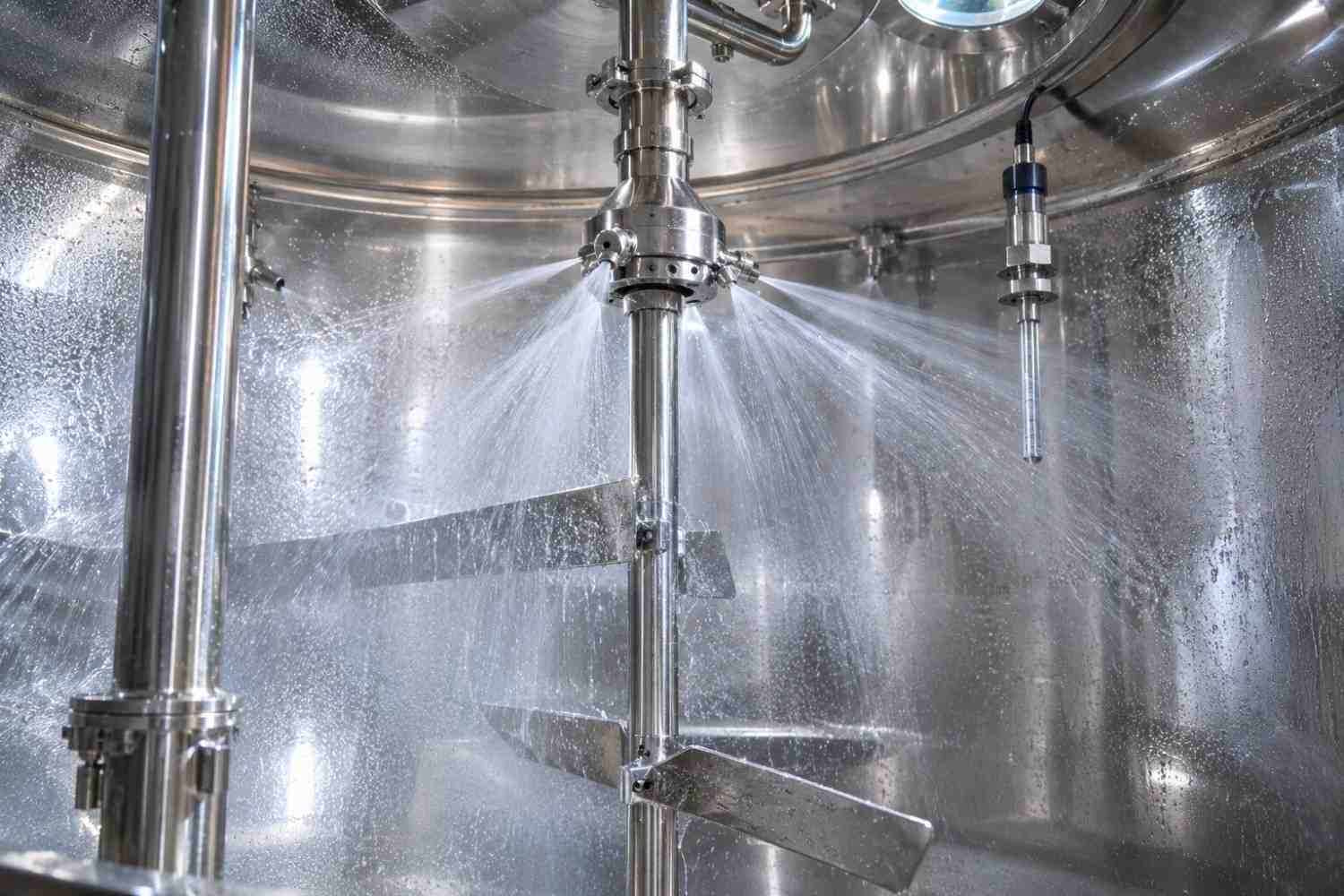
A spray ball is a head installed inside a tank that distributes cleaning fluid received from the CIP line across the internal surfaces of the vessel. It is typically suspended inside the tank from a top dome nozzle. Pressurized cleaning fluid enters the head, exits through holes or nozzles, impacts the tank walls, and flows downward under gravity to wash the surfaces.
Static Spray Balls
Static spray balls are stationary heads featuring perforations in a specific pattern. Having no moving parts, they offer a simple, robust, and self-cleaning design. Their cleaning action relies heavily on the fluid film cascade flowing down the surface combined with chemical action.
Static spray balls are an economical and effective solution, particularly for small to medium-sized tanks with easily soluble soils. However, they require high flow rates and offer limited impact when removing sticky, dried, or baked-on residues.
Rotary Spray Heads
Rotary spray heads rotate around their own axis driven by the flow of the cleaning fluid, distributing the liquid in fan-shaped jets. This rotational movement delivers a stronger impact against the surface, enhancing mechanical cleaning action. Consequently, achieving the same cleaning result often requires lower flow rates and less chemical consumption compared to static spray balls.
Jet (Multi-Axis) Cleaning Heads
Jet cleaning heads rotate multiple high-impact fluid jets across two axes, sweeping the entire inner tank surface in a defined indexing pattern. Thanks to their high impact force, they excel at cleaning stubborn soils, large vessels, and heavy-residue equipment such as fermentation tanks. Cleaning cycles are programmed based on calculated pattern completion times. Although initial investment costs are higher, they yield substantial savings in water, chemical, and energy consumption.
Key Criteria for Selection
- Soil type: Static spray balls may suffice for easily soluble residues, whereas sticky or baked-on soils demand stronger mechanical action.
- Tank dimensions and geometry: Tank diameter and height dictate the effective throw distance of the cleaning head.
- Internal components: Agitators, baffles, and dip tubes create shadow zones, potentially requiring multiple cleaning heads.
- Flow rate and pressure: The CIP supply pump and distribution piping must supply the required flow rate and operating pressure for the chosen head.
- Hygienic design: The spray device itself must be self-draining, fully cleanable, and manufactured from compliant materials.
- Validation: The selected configuration must be verifiable by testing to ensure complete surface coverage.
Shadow Zones and Head Positioning
Agitator shafts, blades, baffle plates, temperature sensors, and internal piping obstruct direct fluid paths from the spray head, creating shadow zones. To ensure these areas are thoroughly cleaned, spray head positions must be selected carefully, adding secondary heads where necessary. Spray head placement should be determined during the tank design phase to position mounting nozzles correctly. Retrospectively fitted spray heads rarely achieve optimal coverage.
Verification of Cleaning Coverage
Ensuring complete spray coverage across all surfaces is typically validated using a riboflavin (vitamin B2) test. In this test, a solution that fluoresces under ultraviolet light is applied to the tank's interior. The cleaning head is then operated, and remaining residues are inspected using a UV lamp. This test provides concrete evidence that the spray head selection and positioning are correct and forms an integral part of qualification in pharmaceutical facilities.
Maintenance and Inspection
Over time, spray ball orifices can clog, and bearings in rotary heads can wear out. Therefore, cleaning heads should be routinely removed for inspection to verify orifice clarity and smooth rotation. Monitoring supply pressure and flow rate during CIP cycles also helps detect performance changes early. Higher-than-expected pressure indicates clogging, while lower pressure points to wear or leaks.
Impact on Energy and Resource Consumption
The choice of cleaning head directly affects a facility's water, chemical, and energy consumption. Operating static spray balls at excessively high flow rates requires heating and pumping large volumes of liquid during every cleaning cycle. Achieving the same cleaning performance in less time with less fluid using more efficient spray heads delivers marked savings—especially in facilities executing multiple CIP cycles daily. However, any modification must be supported by coverage testing and cleaning validation; resource efficiency should never compromise hygiene assurance.
Frequently Asked Questions
How many spray balls are required per tank?
This depends on tank size, geometry, and internal fittings. While a single head may suffice for small tanks without internal components, large or agitated tanks often require multiple heads. The final layout must be validated through coverage testing.
Does upgrading from a static spray ball to a rotary spray head yield savings?
In most cases, water and chemical consumption are reduced. However, you must verify that the existing CIP system's flow rate and pressure suit the new head, followed by re-validating cleaning efficacy after installation.
What material should spray balls be made of?
In hygienic applications, AISI 316L stainless steel is standard. For rotary heads, internal bearing materials must also withstand high temperatures and aggressive cleaning chemicals.
Selecting the right spray head requires evaluating soil type, tank geometry, internal components, and CIP system capacity together. The correct head type and positioning shorten cleaning cycle times, reduce resource consumption, and deliver verifiable hygiene. To design the optimal cleaning solution for your process tanks, visit our CIP systems page or contact us directly.