

What Is a Riboflavin Test? Verifying Tank Cleaning Coverage
- Blog
- What Is a Riboflavin Test? Verifying Tank Cleaning Coverage
What Is a Riboflavin Test? Verifying Tank Cleaning Coverage
Table of Contents
- What is a Riboflavin Test?
- Why is the Test Performed?
- Pre-Test Preparation
- How is the Test Performed?
- Evaluation of Results
- What to Do if the Test Fails?
- Difference Between Riboflavin Testing and Cleaning Validation
- Reporting
- When Should the Test Be Repeated?
- Frequently Asked Questions
- Conclusion
It is not enough to simply state that a tank's cleaning system is correctly designed; it must be demonstrated. Particularly in pharmaceutical and biotechnology facilities, it must be proven through a concrete test that the cleaning fluid reaches all internal surfaces of the vessel. The most widely used method for this purpose is the riboflavin test. In this article, we cover what a riboflavin test is, how it is performed, and how the results are evaluated.
What is a Riboflavin Test?
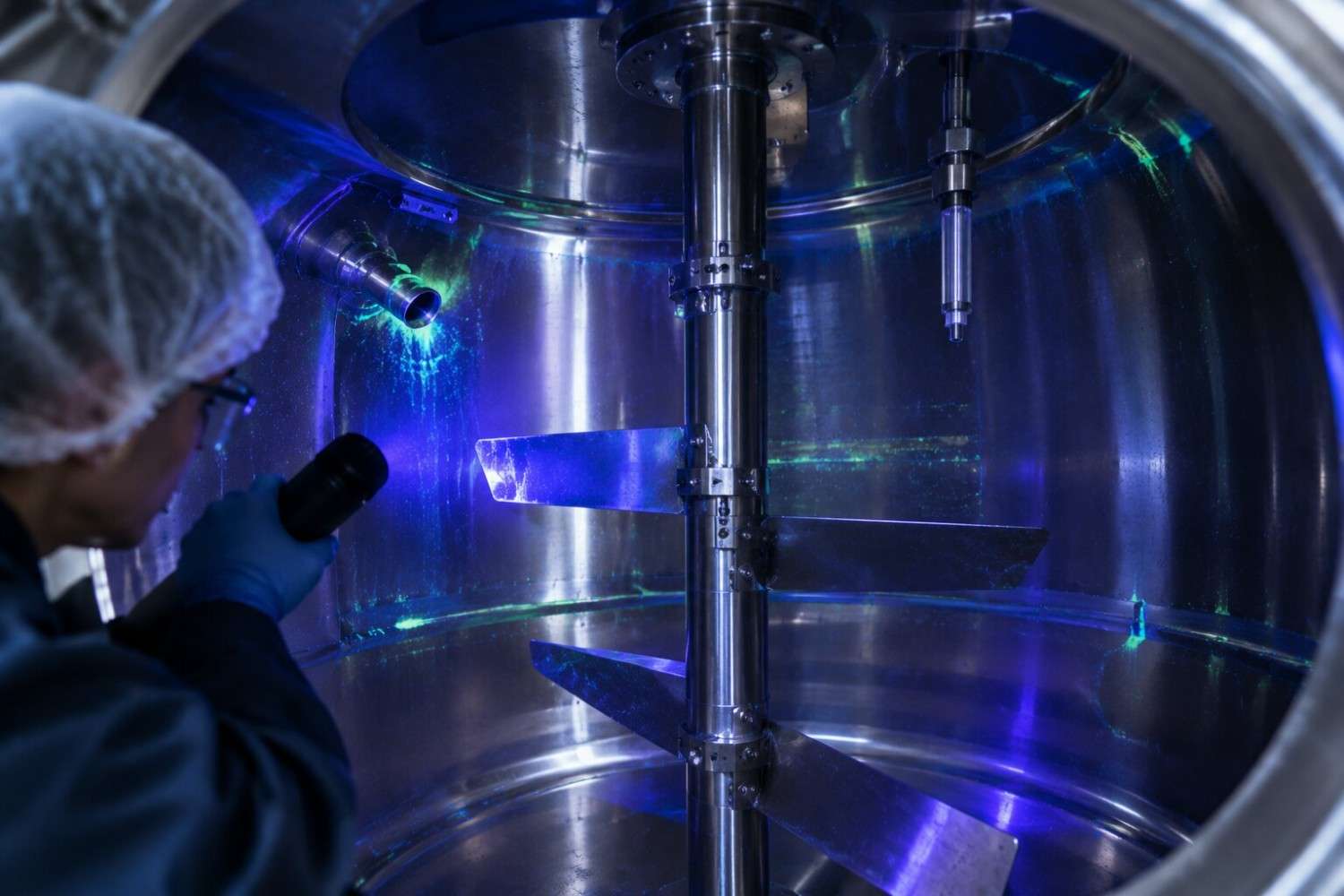
Riboflavin, also known as vitamin B2, is a water-soluble compound that fluoresces brightly under ultraviolet light. In a riboflavin test, this solution is applied to the internal surfaces of the tank, after which the spray head is operated using water only. At the end of the test, the surfaces are inspected with a UV light. Surfaces showing no fluorescence indicate where the cleaning fluid has reached, whereas glowing spots reveal areas where the cleaning fluid failed to sufficiently penetrate.
Riboflavin is non-toxic and easily rinsed away with water. These characteristics make it an ideal tracer agent for coverage testing in hygienic equipment.
Why is the Test Performed?
The primary objective of the riboflavin test is to demonstrate that the selection and positioning of the cleaning head achieve complete coverage across all tank surfaces. Shadow zones—such as agitator shafts, baffle plates, nozzle interiors, and top domes—can be overlooked during the design phase. The test exposes such deficiencies before production begins. Furthermore, it provides objective evidence of the cleaning system's suitability during the qualification process.
Pre-Test Preparation
- Checking that the tank interior is visually clean and dry
- Determining the concentration and preparation method of the test solution
- Verifying that the cleaning head, CIP line, and pump are operational
- Defining flow rate, pressure, and duration parameters to represent actual CIP conditions
- Preparing the UV lamp, camera, and recording forms
- Documenting acceptance criteria in writing beforehand
How is the Test Performed?
The riboflavin solution is applied evenly across the tank's internal surfaces, typically using a spray applicator. All product-contact surfaces—including the top dome, sidewalls, bottom dish, nozzle interiors, agitator, and other internal fittings—must be thoroughly coated. Following application, surfaces are inspected under UV light to confirm that the solution has indeed reached all areas.
Next, the spray head is operated under defined conditions, typically using water only. The run time is selected to represent the corresponding cycle step in the actual CIP program. After draining the tank, internal surfaces are systematically inspected in a darkened environment using a UV lamp.
Evaluation of Results
At the end of the inspection, no fluorescent residue should remain on any surface. Any glowing spots are photographed and their locations recorded. These spots signify shadow zones missed by the spray head. During evaluation, special attention must be paid to nozzle interiors, the rear surfaces of agitator blades, and the perimeter of the top dome. The tank drain point and surrounding outlet valve must also be included on the checklist.
What to Do if the Test Fails?
When glowing spots remain, the root cause is investigated first. Insufficient flow rate, incorrect head positioning, clogged nozzles, shadowing internal components, or an improperly selected head type are the most common causes. Corrective measures may include repositioning the head, adding a secondary head, increasing flow rate, or changing the head type. Following any modification, the test is repeated and the results re-documented. This cycle continues until complete coverage across all surfaces is achieved.
Documenting changes made after a failed test is equally critical. Every adjustment to head positioning or flow rate must be formally defined so maintenance teams can operate the system under identical conditions in the future. Otherwise, a setting successfully validated during testing may inadvertently drift over time, compromising cleaning coverage once again. Recording final settings in the CIP recipe and maintenance instructions eliminates this risk.
Difference Between Riboflavin Testing and Cleaning Validation
A riboflavin test proves that cleaning fluid reaches the surfaces; however, it alone does not prove that a surface is analytically clean. Cleaning validation, on the other hand, uses analytical methods to demonstrate that actual product residue is reduced below acceptable limits by the established cleaning program. Consequently, the riboflavin test is considered a prerequisite for cleaning validation. Conducting validation studies on a system whose coverage has not been verified is ineffective.
Reporting
The test report includes the tank specification, head type and positioning, preparation of the test solution, applied flow rate, pressure, duration, inspection method, photographs and locations of any residual fluorescence, corrective actions taken, and the final outcome. The report is finalized with signatures from the testing and witnessing personnel and appended to the facility's qualification documentation.
When Should the Test Be Repeated?
The riboflavin test is typically performed once during commissioning; however, specific modifications may require the test to be repeated. Examples include changing the type or position of a cleaning head, installing new internal components inside the tank, or replacing the CIP pump or supply piping. Identifying these triggers within the change management process ensures the test is not omitted when necessary.
Some facilities choose to repeat coverage testing at periodic intervals even in the absence of physical modifications. This approach helps identify performance degradation over time, such as head wear or partial nozzle blockages. Periodic re-testing frequency can be established using a risk-based approach according to vessel criticality and cleaning head design.
Frequently Asked Questions
Is riboflavin testing performed only on tanks?
While tanks represent the most common application, the test can also be applied to blenders, filter housings, and other enclosed equipment cleaned by spray devices.
Are cleaning chemicals used during the test?
Generally, no. The objective is not to evaluate chemical action, but to physically demonstrate whether liquid reaches the surfaces. For this reason, the test is typically performed using water only.
Is a separate test required for partially filled tanks?
The test is performed with the tank empty and covers all internal surfaces. While different fill levels are relevant during production, the goal from a cleaning coverage perspective is to verify every surface.
The riboflavin test is a simple yet powerful method for validating the design of a cleaning system. When executed with proper preparation, realistic test parameters, and comprehensive documentation, it supports the qualification process while uncovering operational risks before production starts. Contact us to plan coverage testing alongside your CIP systems and tank manufacturing projects.