



Choosing a Hygienic Pump: Centrifugal or Positive Displacement?
- Blog
- Choosing a Hygienic Pump: Centrifugal or Positive Displacement?
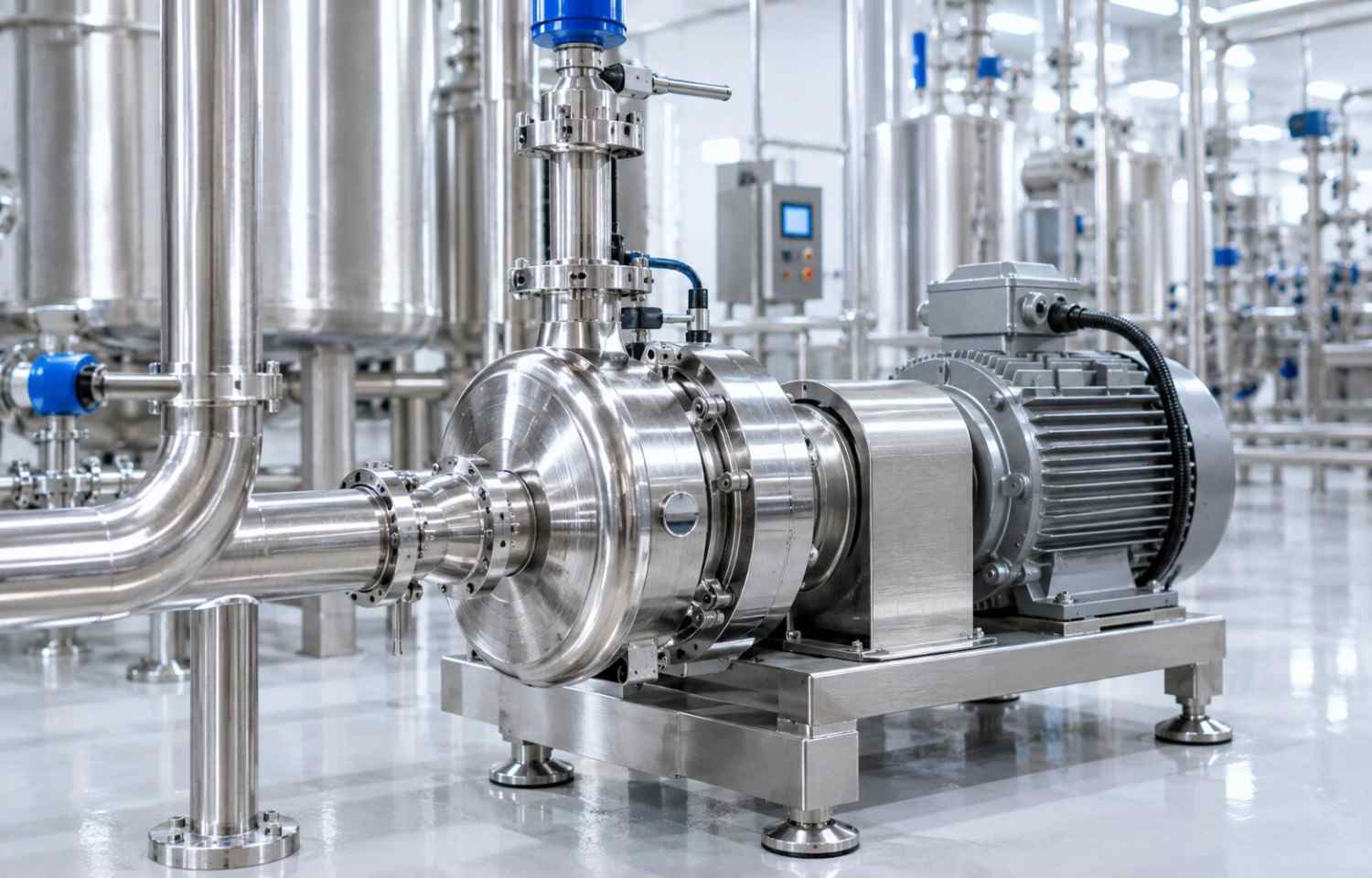
Choosing a Hygienic Pump: Centrifugal or Positive Displacement?
Table of Contents
- What is a Hygienic Pump?
- Centrifugal Pumps
- Positive Displacement Pumps
- Key Selection Criteria
- Pump Selection During CIP
- Cavitation and Suction Line Design
- Mechanical Seal Selection
- Energy Efficiency
- Pump Placement and Installation
- Frequently Asked Questions
- Conclusion
In food, beverage, pharmaceutical, and cosmetic facilities, pumps that transfer product from one point to another sit at the heart of the process. An incorrectly selected pump can lead to product degradation, efficiency loss, cleaning issues, and high maintenance costs. In this article, we compare the two most commonly used pump families in hygienic applications—centrifugal and positive displacement pumps—and cover the criteria that must be considered to make the right choice.
What is a Hygienic Pump?
A hygienic pump is a pump whose product-contact surfaces are made of stainless steel and whose internal geometry is designed to be cleanable and drainable. Mechanical seals, gaskets, and connection details are selected to prevent product accumulation. Hygienic pumps are expected to be suitable for Clean-in-Place (CIP) and, when necessary, Sterilization-in-Place (SIP) operations.
Centrifugal Pumps
Centrifugal pumps operate on the principle of imparting kinetic energy to the liquid via a rotating impeller. They have a simple construction, are easy to maintain, and can economically meet high flow rate requirements. For water-like, low-viscosity liquids, they are generally the first choice.
Centrifugal pumps also have limitations. As viscosity increases, their efficiency drops significantly. Flow rate varies depending on system pressure, which can be a disadvantage in applications requiring precise dosing. Additionally, high-speed rotating impellers can degrade the structure of shear-sensitive products.
Positive Displacement Pumps
Positive displacement pumps entrap a specific volume of liquid in each revolution and deliver it to the discharge line. Rotary lobe pumps, circumferential piston pumps, twin-screw pumps, and peristaltic pumps are common examples of this family in hygienic applications.
The key advantage of these pumps is that the flow rate is largely independent of system pressure. They can gently convey high-viscosity products, mixtures containing solids/particulates, and shear-sensitive fluids. On the other hand, their design is more complex, initial investment costs are generally higher, and safety measures are required to prevent operation against a closed discharge line.
Key Selection Criteria
- Viscosity: Centrifugal pumps excel with low-viscosity liquids, while positive displacement pumps take the lead with high-viscosity products.
- Shear Sensitivity: For emulsions, creams, products with fruit pieces, and certain biological fluids, pumps that ensure gentle handling should be selected.
- Flow Rate and Pressure Requirements: Positive displacement pumps offer an advantage in dosing and filling applications where a constant flow rate is needed.
- Cleanability: It must be evaluated whether the pump can deliver the required cleaning flow velocity during CIP and whether all internal surfaces fully contact the cleaning solution.
- Suction Conditions: Tank level, suction line length, and product temperature affect the risk of cavitation.
- Maintenance: Seal replacement ease, rotor accessibility, and spare parts availability determine operating costs.
Pump Selection During CIP
In many facilities, the same pump is used for both product transfer and cleaning operations. Cleaning typically requires achieving a specific fluid velocity. A positive displacement pump optimized for product transfer may not provide the high flow rate required during CIP. In such cases, either the pump capacity is sized according to the cleaning demand, or a separate centrifugal pump with a bypass line is used for CIP. This decision should be made alongside the CIP system design.
Cavitation and Suction Line Design
Pump selection is not limited solely to the pump unit itself. Suction line diameter, length, number of elbows, and the elevation difference between the tank and pump are critical for smooth pump operation. If suction-side pressure is insufficient, cavitation occurs, leading to noise, vibration, efficiency loss, and eventual impeller or rotor damage. This risk is higher with hot products and volatile liquids. Keeping the suction line as short and straight as possible, while avoiding unnecessary valves and fittings, is a key design principle.
Mechanical Seal Selection
Sealing in hygienic pumps is usually provided by mechanical seals. A single mechanical seal is sufficient for most food applications. For crystallizing, sticky, or sterile products, a double mechanical seal with a flushing system may be preferred to cool or wash the seal faces. The selection of seal face materials and elastomers must be compatible with the product, operating temperature, and cleaning chemicals.
Energy Efficiency
Pumps can account for a significant portion of a facility's energy consumption. Selecting a pump close to its Best Efficiency Point (BEP) and adjusting the flow rate according to demand using a variable frequency drive (VFD) reduces energy consumption. Oversized pumps operated by throttling valves lead to both wasted energy and accelerated wear.
Pump Placement and Installation
The performance of a correctly selected pump is directly tied to installation details. Positioning the pump to ensure self-draining, preventing fluid retention at the lowest point of the housing, and allowing easy removal of the pump without dismantling the pipeline during maintenance are integral parts of hygienic design. Making stress-free connections between the pump and the piping system is equally important; an installation that transfers piping weight or thermal expansion loads onto the pump casing shortens seal and bearing life. Therefore, pipe supports and flexible connections around the pump must be addressed together with the pump during the engineering phase.
Frequently Asked Questions
Can the same pump be used for different products?
Yes, but if the products differ in viscosity and shear sensitivity, you must verify that the pump operates within a suitable operating range for all products. A validated cleaning procedure is also required between product changes.
Lobe pump or twin-screw pump?
Both provide gentle fluid handling. The choice should be made based on product characteristics, particle size, pressure demands, and cleaning methods. Manufacturer test data and experience from similar applications help guide the decision.
How often should a pump be serviced?
Maintenance intervals are determined by operating hours, product characteristics, and cleaning frequency. By regularly monitoring seal condition, vibration, and noise, maintenance requirements can be identified in advance.